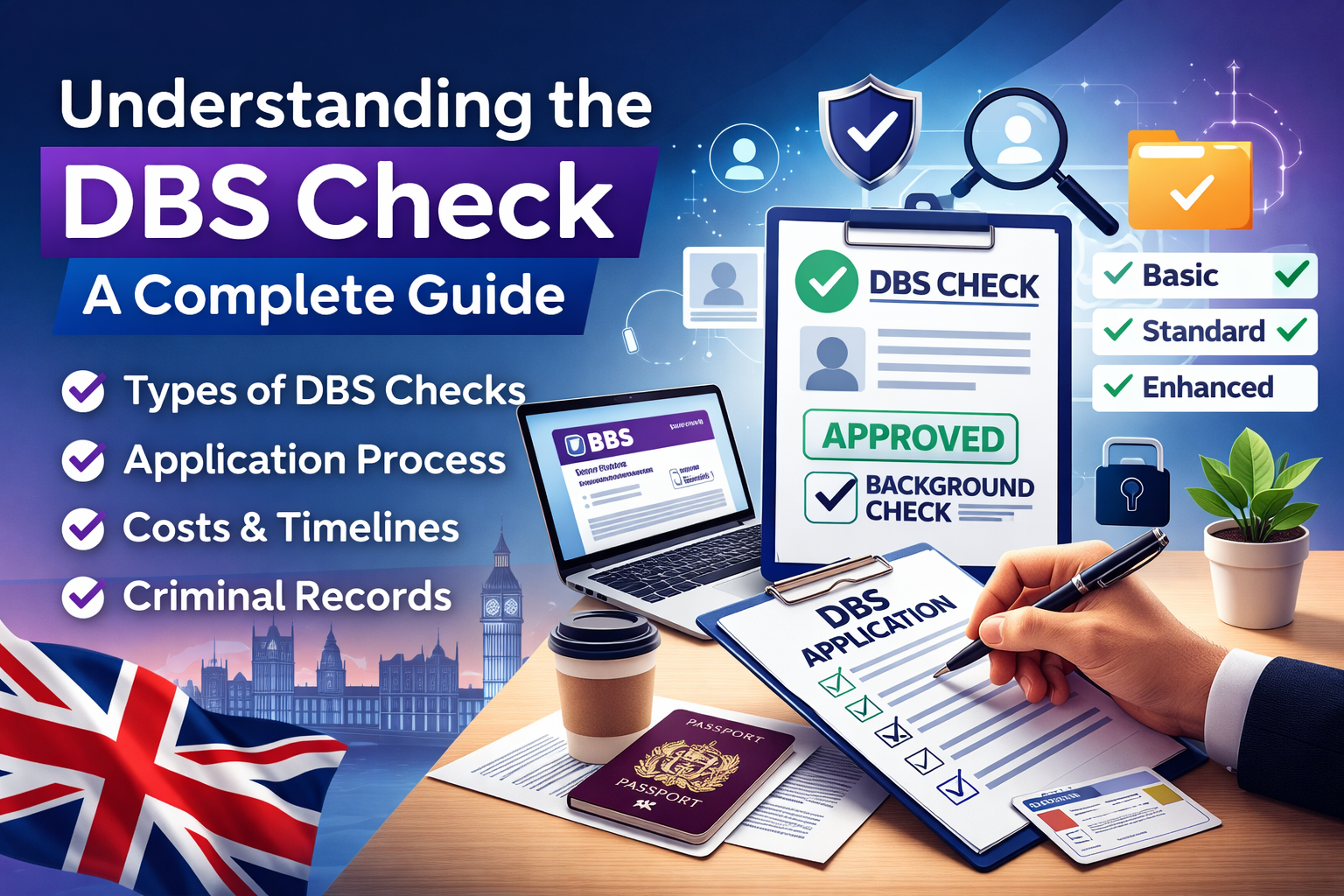
Navigating Your DBS Check: A Complete Guide to the UK DBS Process
For many people across the UK, a DBS check is one of the first hurdles to clear before starting a new role. Whether you’re applying for a job in healthcare, education, finance, or security, understanding how the DBS process works — and what to expect — can save you time, stress, and confusion.
This guide covers everything you need to know: the different types of DBS check, eligibility, how to apply, typical processing times, costs, and what happens if you have a criminal record.
What is a DBS Check?
A DBS check — short for Disclosure and Barring Service check — is an official criminal record check issued by the DBS, an executive agency of the Home Office.
It gives employers access to relevant criminal record information to support safer recruitment decisions. The level of detail disclosed depends on the type of check requested and the nature of the role.
It’s worth noting: the DBS does not decide whether you’re suitable for a position. That decision always rests with the employer.
Types of DBS Check: Which One Do You Need?
There are three levels of DBS check in the UK, each designed for different roles and circumstances.
Basic DBS Check
A Basic DBS check is the entry-level option. It discloses:
- Unspent convictions
- Unspent conditional cautions
Spent convictions do not appear. Individuals can apply directly, and it’s suitable for a wide range of general employment, licensing applications, and self-employed contractors.
Standard DBS Check
A Standard DBS check goes further, disclosing:
- Spent and unspent convictions
- Cautions, reprimands, and final warnings
Information is sourced from the Police National Computer (PNC). Only employers can request a Standard check, and the role must be eligible under the Rehabilitation of Offenders Act (ROA) Exceptions Order. It’s commonly used in legal, financial, accountancy, and security roles.
Enhanced DBS Check
An Enhanced DBS check is the most thorough level. In addition to everything in a Standard check, it includes:
- Relevant information held by local police forces
- Children’s Barred List check (where applicable)
- Adults’ Barred List check (where applicable)
Enhanced checks are required for roles involving regulated activity with children or vulnerable adults — including teaching, nursing, social work, care work, and event safeguarding roles.
Who is Eligible for a DBS Check?
Eligibility is determined by the role, not the individual.
- Basic: Available for almost any role
- Standard: Roles listed under the ROA Exceptions Order
- Enhanced: Roles involving regulated activity or close contact with vulnerable groups
Employers are legally required to justify the level of check they request. Requesting a higher level than a role qualifies for is unlawful.
How the DBS Process Works: Step by Step
1. The Employer Confirms Eligibility
Before anything else, the employer determines which level of check is appropriate for the role.
2. Application Submission
Standard and Enhanced checks are submitted by the employer or an umbrella body. Basic checks can be completed online directly by the applicant.
You’ll need to provide:
- Full name and any previous names
- Date of birth
- Five years of address history
- National Insurance number (recommended)
- Valid identity documents
3. Identity Verification
Original documents must be verified in line with DBS ID checking guidelines — either in person or digitally, depending on the provider.
4. DBS Processing Stages
Your application moves through the following stages:
- Application received
- Police National Computer search
- Barred list check (if applicable)
- Local police records check (Enhanced only)
- Certificate printed and dispatched
You can monitor progress using the official DBS tracking service.
5. Certificate Issued
The DBS certificate is sent directly to the applicant — not the employer. It’s your responsibility to share it with them.
How Long Does a DBS Check Take?
Typical turnaround times are:
| Check Type | Typical Processing Time |
|---|---|
| Basic DBS | 1–7 days |
| Standard DBS | 1–2 weeks |
| Enhanced DBS | 2–6 weeks |
Delays are most often caused by local police checks, incomplete address history, identity document issues, or name and date-of-birth matches that require manual review. Enhanced checks are the most variable due to police force involvement.
How Much Does a DBS Check Cost?
Current government fees are:
| Check Type | Government Fee |
|---|---|
| Basic DBS | £20.00 |
| Standard DBS | £20.00 |
| Enhanced DBS | £41.00 |
Many employers cover the cost on behalf of applicants. Umbrella bodies may also charge an additional administration fee on top of the government rate.
What Appears on a DBS Certificate?
What shows on your DBS certificate depends on the check level and whether offences are spent or filtered under DBS filtering rules.
Filtering rules mean that certain old or minor convictions may not be disclosed on Standard or Enhanced checks. The key factors are:
- Type of offence
- Your age at the time of the offence
- Time elapsed since the offence
- Whether it resulted in a custodial sentence
- Whether it appears on the specified offence list
Basic checks never disclose spent convictions.
Will a Criminal Record Affect My Application?
Having a criminal record does not automatically disqualify you from employment. Employers are required to assess each case individually, taking into account:
- The relevance of the offence to the role
- The seriousness of the offence
- How much time has passed
- Any pattern of behaviour
- Evidence of rehabilitation
For example, a minor driving offence is unlikely to affect a teaching application, whereas a fraud conviction would carry more weight in a financial services role. Employers must follow fair recruitment guidance and cannot apply blanket bans.
Can You Reuse Your DBS Certificate?
A DBS certificate cannot be formally transferred between employers. However, by signing up to the DBS Update Service within 30 days of receiving your certificate, employers can check your status online without you needing to apply again — provided the role type remains the same.
The Update Service costs £15 per year and is particularly useful for contractors, agency workers, event staff, and anyone working across multiple organisations.
Frequently Asked Questions About the DBS Process
Does a DBS check expire? There is no official expiry date. Each employer sets their own renewal policy.
Can I start work before my DBS check comes back? Some employers allow supervised work pending the result, based on a risk assessment.
What if there’s an error on my certificate? You can raise a formal dispute with the DBS within three months of the certificate being issued.
Will my employer see my full criminal record? They will only see what appears on the certificate you choose to share with them.
Understanding the DBS process puts you in a stronger position, whether you’re applying for your first DBS check or managing multiple checks across different roles. If you have further questions, our team is here to help.